| Gemma Bonham-Carter |
AI + online marketing / thursdays |
|
Noted Issue 1 is officially out in the world, and honestly, the response blew me away. My inbox filled up with replies from people telling me what landed, what they were going to try that same weekend, and what they wanted more of. A few that stuck with me:
“Love Noted, Gemma! So helpful and fun to hear the latest in AI and how you’re using it.” (Laura)
“I just read through Noted Issue 1, and I LOVE it! I love the layout, the way it’s broken down, everything!” (Morgan)
“Love this and everything you do. Duly noted ;)” (Audrey)
“Love it!! I’m always interested in what industry leaders are doing in the right now.” (Tracy)
I read every single one. Starting something new is always a bit of a gamble, so thank you for showing up for it.
You also told me the font was too small to read comfortably on your phone, and more than one of you threatened to break out a magnifying glass. Fair - haha! We’re testing a few different sizes over the next couple of issues to find what reads easily on every screen, so if things look slightly different from last week, that’s why.
Keep the feedback coming, because it’s genuinely shaping this thing.
Alright, let’s get into what’s going on this week.
|
| |
| In this email |
| [ 01 ] |
Claude watermarks every word it writes. That doesn’t make your work AI. |
| [ 02 ] |
Claude just moved into your browser, all of it |
| [ 03 ] |
OpenAI built ChatGPT for Teens, and my honest mom take |
| [ 04 ] |
Where does your AI actually get its answers? |
|
| 🤖 The big one |
01 |
Claude Watermarks Every Word Now. That Doesn’t Make Your Work “AI”.
|
|
|
Did you see my post last week about the Canva background remover “scandal”? (if you missed it, what happened was that if you use certain Canva features to make your images, Meta now labels them AI). Same story just landed on the text side.
Claude models released on or after August 2 now embed an invisible watermark in the text they generate. It’s a pattern in word choice, not a hidden character or a tag.
First, just so we’re clear: You can’t see the watermark, neither can your reader, and it doesn’t carry anything that traces back to you, your business, or your chats.
It’s EU AI Act compliance, applied globally with no opt out, because there’s no clean way to scope it by region yet.
Now the part that’s getting lost, which is the reason I wrote this up. Watermarked does not mean fully AI-generated. Anthropic says so outright: the mark shows Claude was likely involved at some point. It can’t tell “Claude wrote this” from “Claude fixed my commas.” It also doesn’t change who owns or authored your work.
Which is exactly the question I raised about Canva. Generative AI invents something from nothing, whereas AI-assisted helps you edit or change something real. Those are very different things, and right now the label treats them the same.
Does it matter to you? Maybe not.
Proofreading and light cleanup barely register, because the mark only lives in words Claude picks. When it’s your draft and Claude fixes your commas, that’s your writing. Facts and code mostly escape it too, since there’s no room for a pattern when there’s only 1 correct next word.
Full rewrites and translations do carry a mark, because every word there is Claude’s. That’s fine, but it still says nothing about whose ideas those are.
Two things people are already getting wrong: This isn’t the same as an AI detector like Pangram. Detector tools read your writing style and make a guess, which is why they’re wrong so often. The watermark isn’t a guess. It’s a hidden pattern Anthropic put there on purpose, and only Anthropic can check for it. Secondly, there’s no public detection tool yet. One is coming, but right now nobody can check your content even if they wanted to.
My take? I’m not worried at this point. Transparency about AI involvement is fine.
What I do keep coming back to though is that a label can’t tell the difference between “I typed a prompt and software invented this” and “I came up with this and had AI tidy it up.” Maybe that only matters to those of us who do this for a living. But if there is any kind of penalization at some point for using AI, then we might start to care. We’ll see.
Ultimately though, the answer has always been to keep doing the work that makes the output yours. Your ideas, your experience, your voice, your edits, those human touch points that make up your thought leadership.
And keep reading, because in section 3 OpenAI just built that exact lesson into a product. For teenagers. It’s cool.
And don’t just take my word for any of this. Anthropic published a full FAQ on exactly how the watermark works, so you can read their own wording rather than someone’s summary of it.
|
|
|
| |
| 🎁 Try this |
02 |
Claude Just Moved Into Your Browser. All of It.
|
|
|
Imagine you’re working away in Claude, and then you need something that lives on the internet. So you go grab the URL, or copy the page, or paste in the text, and bring it back. That little round trip just got a lot shorter.
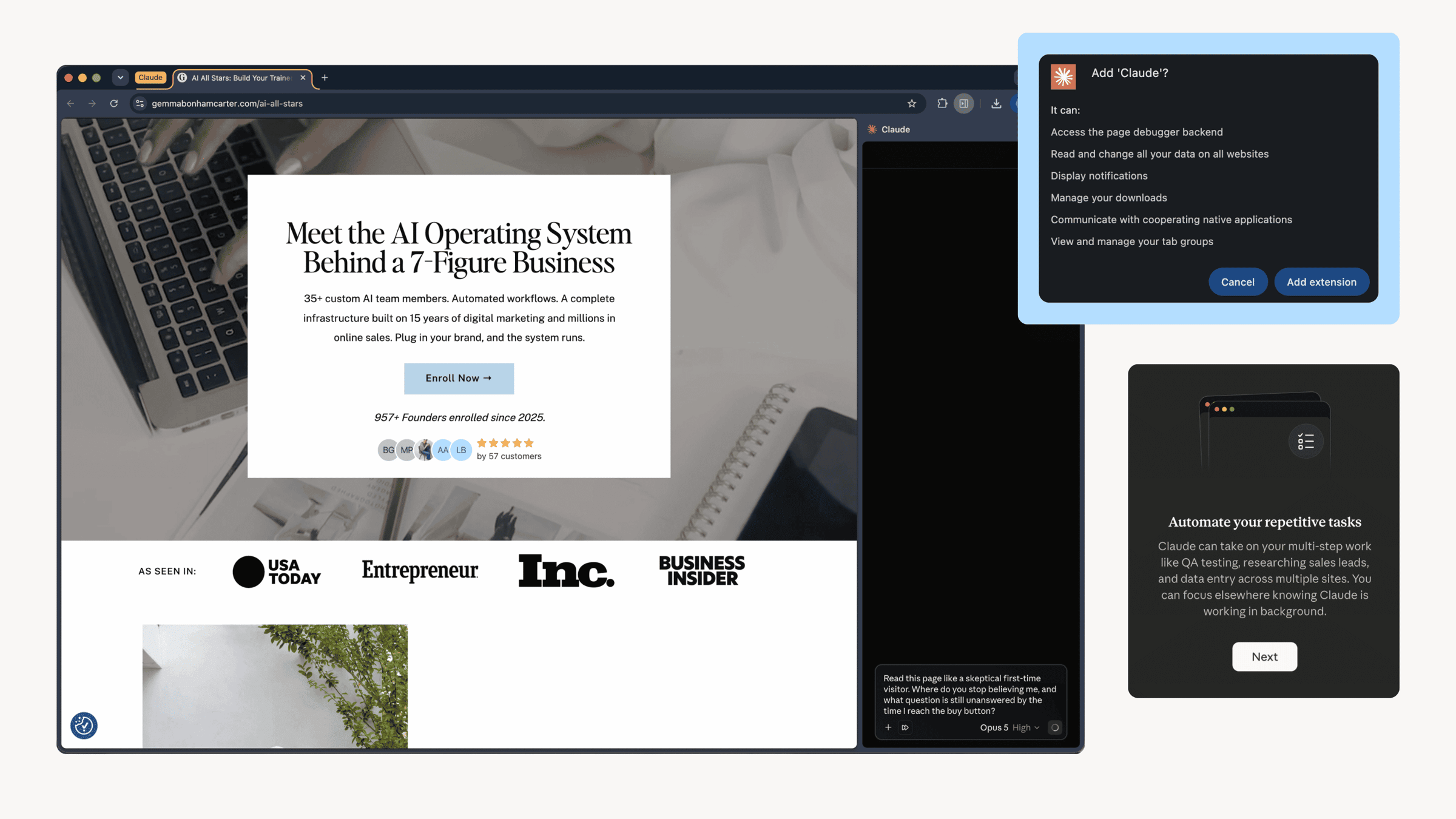
Claude has a Chrome extension that opens in a side panel next to whatever page you’re on. Until this month it had the memory of a goldfish, walled off from your real account with no saved history, no skills, no connectors. As of August 12 that panel runs a full Claude session. Your conversations save, your skills and connectors work in there, and anything you start in the browser you can pick up later on desktop or mobile.
The good part is that Claude can see the page you’re on and act on it, clicking, typing, and filling out forms with your existing logins. So it works on the live thing in front of you instead of a copy you pasted in 2 weeks ago.
The fine print: Max and Team have it now, Pro is rolling out over the coming weeks. It’s Chrome specifically, not Edge or Brave, and you still need the desktop app to work with files on your computer. Anthropic is also honest that letting Claude work inside your logged-in browser carries real risk, because a sketchy page can hide instructions meant to redirect it. So start on sites you trust and actually watch the first few runs.
After you’ve installed Claude in Chrome from the Chrome Web Store, here are some ways to use it:
|
| • |
Pull last month’s numbers off your Stripe or ThriveCart dashboard and have Claude tell you what changed, without exporting anything. |
| • |
Sit on your own website and ask what a first-time visitor would still be confused about or do a deep dive of your own sales page (prompt: “Read this like a skeptical first-time visitor. Where do you stop believing me, and what question is still unanswered by the time I hit the buy button?”) |
| • |
Have Claude read a long Reddit or Facebook thread in your niche and pull out the exact language people use to describe their problem. |
| • |
Pull the details out of a booking confirmation or invoice and drop them somewhere useful. |
| • |
Fill out an intake or application form. |
| • |
Compare 3 open tabs of software pricing pages and get a straight answer on which one fits you. |
|
|
|
| |
| 👀 Honest take |
03 |
OpenAI Built ChatGPT for Teens, and My Honest Mom Take.
|
|
|
OpenAI launched ChatGPT for Teens this week. It’s a separate experience for ages 13 to 17, and if ChatGPT estimates you’re under 18, it moves you into it automatically.
I read the announcement twice. Once as a business owner, once as a mom whose oldest is close to that age bracket. How to navigate teens using AI is a very real topic in my household.
The protections are what you’d hope for. Things like stricter filters around self-harm, eating disorders and explicit content, break reminders, safety alerts to parents in high-risk situations, and this line: “it should not use romantic language, encourage emotional dependence, or imply it has feelings”. An AI that isn’t allowed to pretend to be your kid’s friend. Good.
But the feature I keep thinking about is the one getting no headlines.
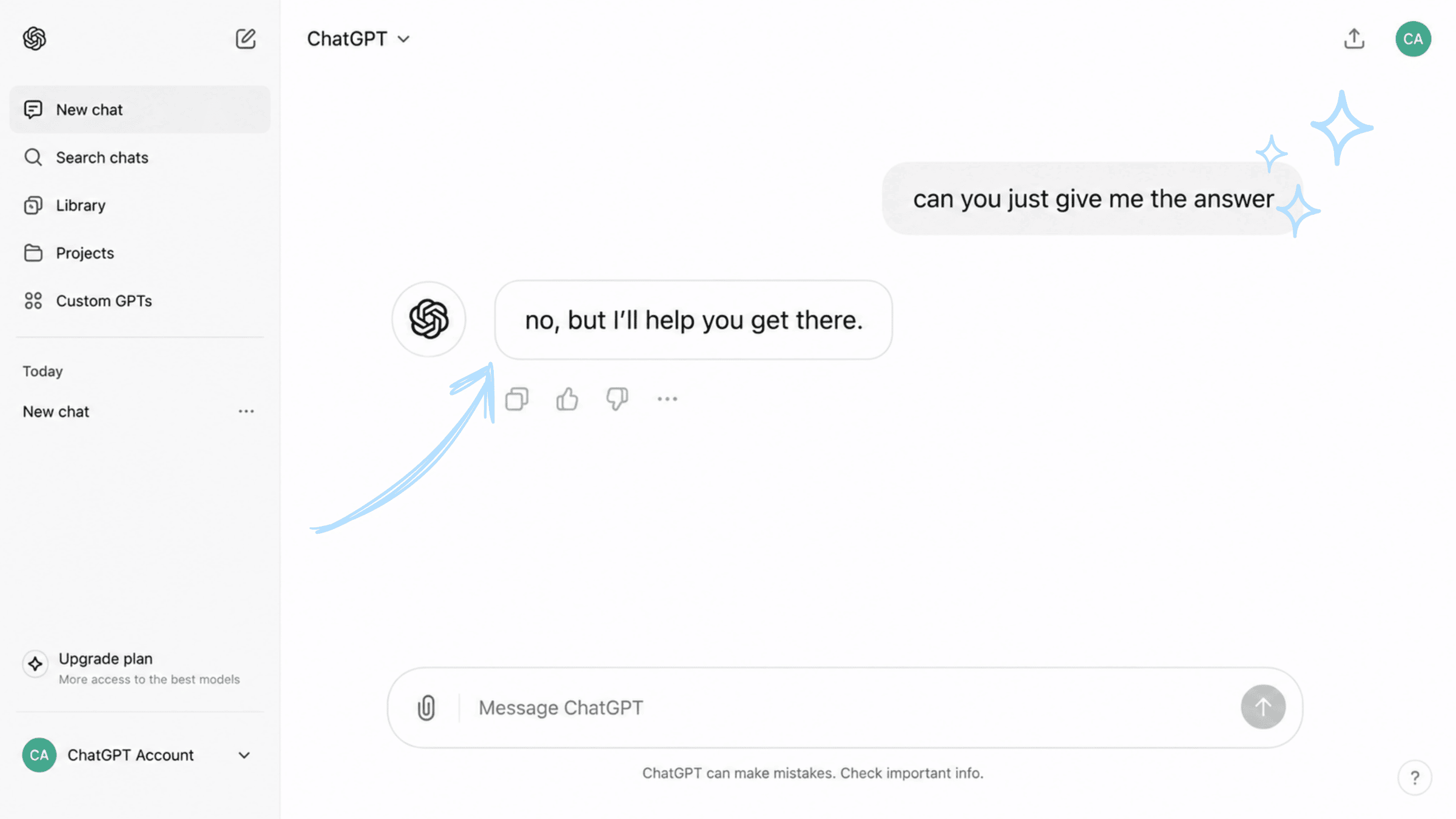
When a teen tries to shortcut their homework, it doesn’t hand over the answer. It slows down and walks them through the problem with guiding questions instead. OpenAI decided to make them actually think.
It sounds good in theory.
How do I really feel about letting my almost-teenager use AI?
I’m so mixed. I love things like creating custom AI “tutors” that can help explain concepts my kids might be struggling with or teaching them how to create and build apps with it.
But am I letting them go rogue on ChatGPT or Claude? No.
In mom mode, I’m super strict when it comes to screen time, social media, and tech in general. I’m all about the 90s childhood and encouraging them to read real books, get bored, bike around the neighbourhood with friends, make crafts, and be creative.
Where do you land on this? Do you like that OpenAI has created a teen version? I'd love to hear your stance.
|
|
|
| |
| 💸 Worth knowing |
04 |
Where Does Your AI Actually Get Its Answers?
|
|
|
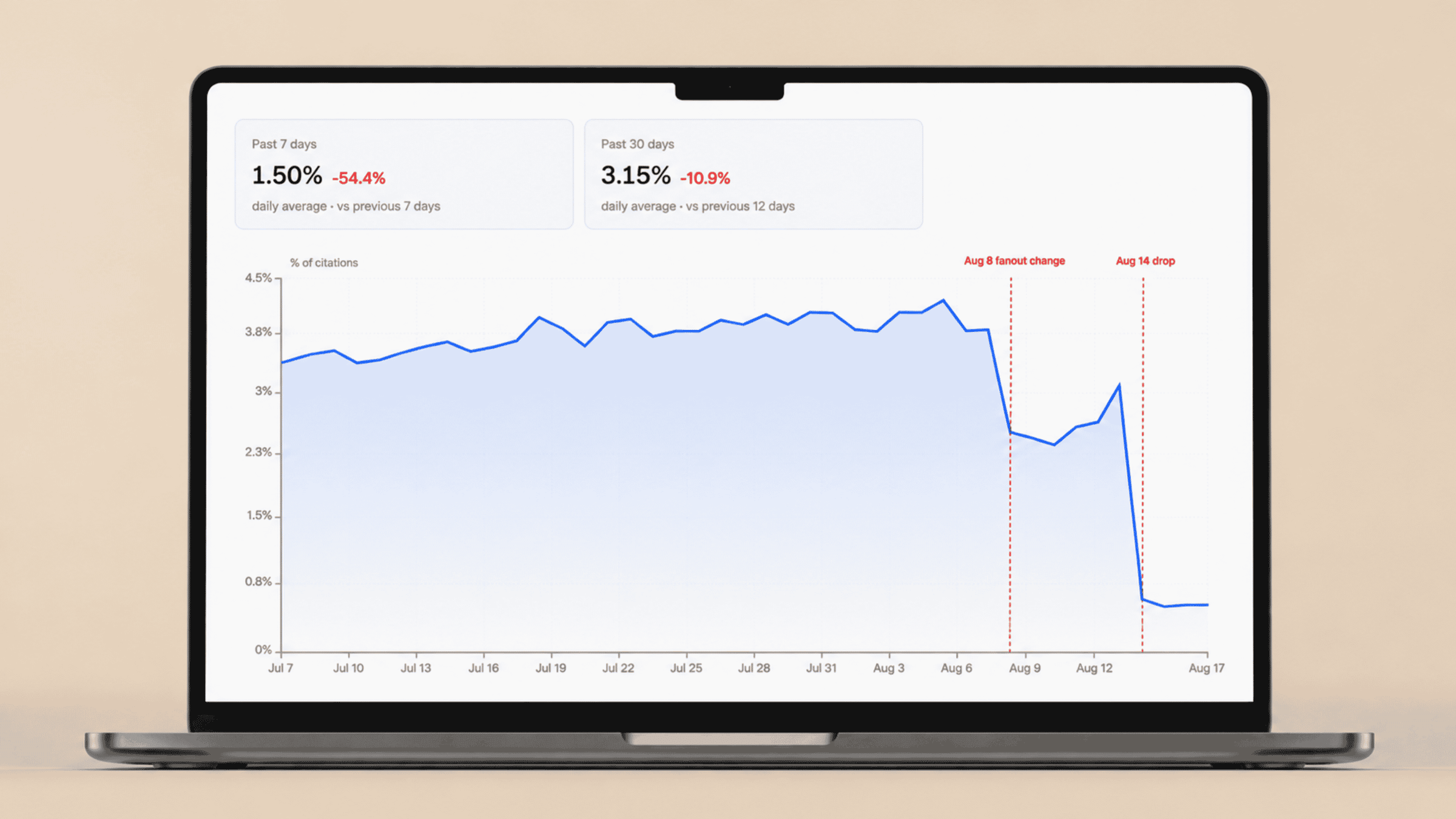
Here’s something that made me stop and think this week. Reddit’s share of ChatGPT Search citations held steady around 3.8% through early August, as one of the biggest shares of any site on the web. But by August 14 it had fallen under 1%, then averaged 0.52% through Aug. 17. An 86% drop in a matter of days, tracked by the AI visibility platform Promptwatch.
Nobody has confirmed why. The best guess is that OpenAI quietly changed how ChatGPT searches the web. Google’s AI tools show Reddit slipping too, just gradually instead of off a cliff.
I’m less interested in Reddit than in what this says about the answers we’re all getting. When you ask ChatGPT or Claude a question, the sources behind that answer shift constantly, and often without an announcement or a reason anyone can point to. Meanwhile more and more sites are blocking AI crawlers entirely, so their information isn’t in the pool at all. Some of the best sources on a topic may simply not be available, and you’d never know.
It doesn’t make AI research useless. I use it every day. It just means the confident paragraph you get back is built on whatever happened to be reachable that week. It’s worth remembering the next time you take an AI answer at face value, especially for anything you’re publishing under your own name.
Food for thought.
|
|
|
| |
|
That’s a wrap.

|
See you next Thursday
Gemma.
|
|
| P.S. |
| If you want the bigger version of this, where AI isn’t a blank chat box you open when you remember it exists but a set of trained assistants that already know your voice, your audience and your offers, that’s AI All Stars. Or start with the free AI workshop to see how it works. |
|
|
|
|